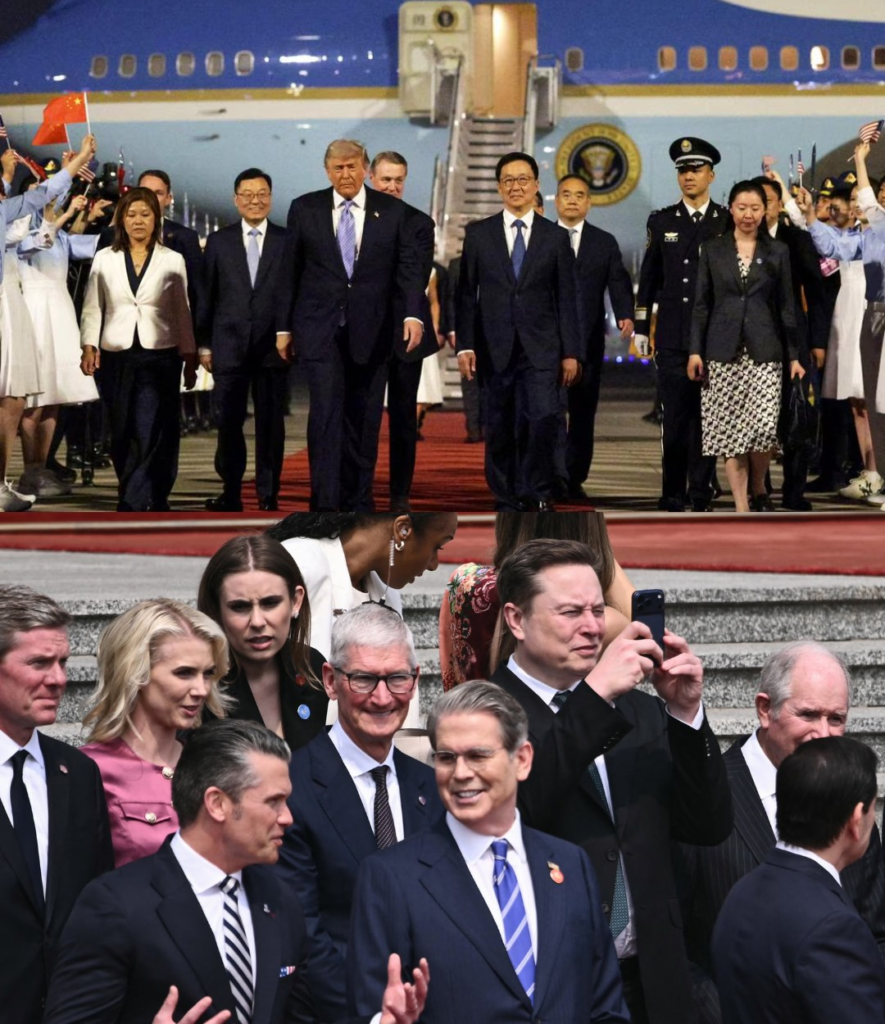
On a bright Beijing morning, the sleek fuselage of Air Force One gleamed under the rising sun, a symbol of American authority and diplomacy. Inside, however, was a scene that has already set political analysts, journalists, and millions of Americans talking. President Donald Trump, known for his decades-long visibility in business and politics, boarded with a delegation of fifteen of the most powerful business leaders on the planet. Together, their wealth exceeded a trillion dollars. Elon Musk, the automotive and space titan, carried $819 billion in personal wealth. Jensen Huang of Nvidia added $183 billion. Stephen Schwarzman, co-founder of Blackstone, added another $47.5 billion. Tim Cook of Apple and the CEOs of Goldman Sachs, BlackRock, Citi, and Boeing completed the circle of influence, each wielding extraordinary economic power and global reach.
Yet, unlike traditional trade missions, this flight’s purpose was unmistakably personal: these billionaires were seeking expanded access to China’s market, and the President of the United States would act as their personal envoy. On arrival, Trump’s remarks to Xi Jinping made headlines immediately: “These brilliant people need China to open up so they can work their magic, and help bring the People’s Republic to an even higher level.” A direct quote, carrying weight, symbolism, and implications beyond trade.
Observers were left grappling with the juxtaposition. On one hand, a foreign nation’s leader. On the other, a U.S. President advocating for private corporate gain while domestic programs essential to millions of Americans faltered. The optics were stark, almost surreal—a sitting President escorting the world’s wealthiest to lobby a foreign authoritarian regime, while at home, tens of millions face food insecurity, healthcare loss, and housing instability.
The Faces Behind the Fortune
Each member of this delegation brings a story, a network, and a set of interests with direct stakes in the outcomes of the meeting. Elon Musk’s Tesla empire depends on China’s market for both revenue and production capacity. Jensen Huang’s Nvidia chips power the global semiconductor supply chain, a critical commodity for AI development and industrial innovation. Stephen Schwarzman’s Blackstone investment firm operates billions of dollars in assets that could benefit from open markets and eased regulations abroad. Tim Cook’s Apple profits hinge on supply chains and sales in China, a market that generates hundreds of billions in revenue annually.
The CEOs of Goldman Sachs, BlackRock, Citi, and Boeing bring influence in financial services, investment, and aerospace. Collectively, this is not a casual delegation—it is a curated assembly of individuals whose personal and corporate fortunes are directly impacted by foreign policy and trade decisions. Onboard, they occupy private cabins, meet with advisers, and strategize on how their presence can shape the negotiations. Meanwhile, millions of Americans at home are excluded from these calculations, facing policy changes that affect their everyday survival.
Adding complexity to the optics is the presence of filmmaker Brett Ratner, whose past allegations of sexual misconduct have remained a point of controversy. The inclusion of a figure like Ratner in a high-profile government delegation raises questions about judgment, vetting, and the message sent to the public. Critics argue that the symbolism of his presence undermines the credibility and moral standing of the mission.
The Domestic Fallout: Cuts That Bite
While Air Force One sliced through the sky toward Beijing, families across the United States were grappling with the consequences of Trump administration policies. Last July, Congress enacted historic cuts to Medicaid and SNAP, affecting the healthcare and nutrition of millions. Analysts project that over the next decade, 10.9 million Americans could lose health coverage, while 2.4 million could lose access to food assistance. The Center for American Progress described it as the largest transfer of wealth from the poor to the rich in U.S. history.
The proposed 2026 budget amplifies these impacts. WIC benefits for breastfeeding mothers are slated to drop from $54 to just $13, jeopardizing nutrition for infants and toddlers. New Section 8 housing vouchers are frozen, leaving low-income families vulnerable to eviction and homelessness. LIHEAP, the federal program ensuring elderly Americans stay warm in winter, faces cuts that could leave entire communities at risk. Rural hospitals, already struggling with staff shortages and declining revenue, are expected to shutter doors, reducing access to emergency care for tens of thousands.
The human cost is staggering. Mothers must prove they “deserve” groceries, disabled Americans are required to re-verify healthcare eligibility every six months, and seniors risk winter without adequate heat. The juxtaposition is impossible to ignore: while billionaires gain access to China’s markets and personal profits, Americans face deprivation at home.
When Policy Serves Profit, Not People
The Beijing flight is emblematic of a broader tension in governance: the balance between private profit and public welfare. Critics argue that Trump’s approach effectively turns the presidency into a personal concierge for global oligarchs. Corporate interests, from Tesla to Nvidia, are elevated above the immediate needs of the nation’s vulnerable populations.
For citizens, the message is chilling: decisions that affect food, health, and housing are subordinated to the economic ambitions of the ultra-wealthy. Meanwhile, foreign engagement is framed as “national interest,” yet the benefits are highly concentrated, and the costs disproportionately borne by those least equipped to bear them.
Observers note that this pattern is consistent with broader trends in policy priorities under the administration. Across multiple domains—energy, finance, healthcare, and trade—legislation has consistently favored corporations and wealthy individuals, often at the expense of the public good. The Beijing flight crystallizes this dynamic in a single, visually and symbolically powerful event.
Social Media’s Immediate Reaction
As news of the flight spread, social media erupted. Images of the delegation disembarking from Air Force One quickly went viral. Hashtags trending globally highlighted outrage, astonishment, and disbelief. Commenters drew immediate contrasts between the delegation’s wealth and power and the domestic hardship caused by policy cuts. Memes, GIFs, and discussion threads reflected a shared understanding: the optics alone communicate the tension between private gain and public need.
Supporters framed the trip as strategic economic diplomacy, emphasizing potential market access, trade growth, and engagement with China. Critics condemned it as an unethical prioritization of private interests, arguing that the President should represent the American people, not a cabal of billionaires seeking profit abroad. The debate quickly transcended politics, raising questions about governance, accountability, and the ethical responsibilities of leadership.

Historical Precedents and Ethical Questions
The tension between private gain and public service is not new in American history. From Gilded Age industrialists lobbying abroad to modern-day corporate influence on trade policy, the intersection of wealth and governance has long been contested. However, few moments match the scale of influence displayed on this Beijing flight, both in the concentration of wealth and in the direct involvement of the sitting President.
Ethical questions abound. Is it appropriate for a head of state to personally lobby a foreign government for the benefit of a few ultra-wealthy individuals? What does this mean for the public perception of leadership? Can domestic priorities truly coexist with corporate-focused international engagement when policy at home actively reduces food, healthcare, and housing access? These are not theoretical questions—they are immediate moral and political considerations that affect millions.
The Human Faces Behind Policy Decisions
While billionaires stand to gain from China’s open markets, millions of Americans experience the tangible effects of domestic austerity. Families navigating the food stamp system, children reliant on school nutrition programs, elderly citizens dependent on heating assistance, and patients at risk of losing hospital access all bear the brunt of policy decisions that prioritize private profit.
Each cut, each reduction, each budgetary freeze has consequences measured not in dollars or statistics but in human suffering. Communities in rural and urban areas alike are directly affected. Kitchens, clinics, and homes become the frontlines of policy, and the contrast between Air Force One’s cabin and domestic hardship could not be starker.
Global Markets, Domestic Consequences
By lobbying China to open markets, the President facilitates the expansion of corporate empires. Tesla cars may sell more easily in Shanghai, Nvidia chips may flow freely, and investment firms like Blackstone may see increased profits. Yet the costs are felt domestically: reduced access to nutrition, healthcare, and housing for Americans who rely on federal support.
This is the moral tension at the heart of the Beijing flight. The juxtaposition between global corporate gain and domestic deprivation illuminates fundamental questions about governance, responsibility, and accountability. While billionaires’ fortunes swell, American families struggle, highlighting a stark divide in whose interests are being served.
The Tarmac as a Symbol
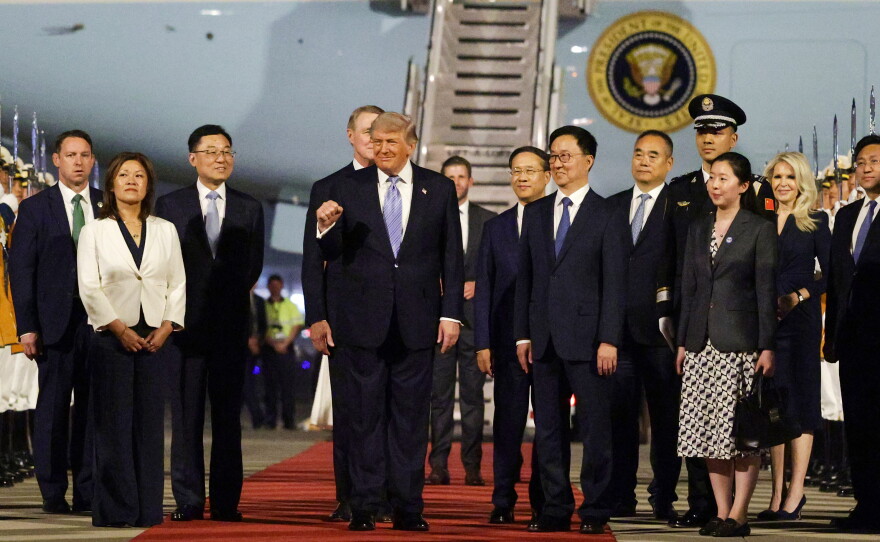
Air Force One on the tarmac in Beijing, with the President and fifteen billionaires, becomes more than a scene—it is a symbol of priorities, influence, and governance. It reflects the concentration of power, the intertwining of political office with private gain, and the stark contrast between those who benefit from policy and those who bear its consequences.
For observers, it serves as a reminder that leadership is not abstract. Every policy choice reverberates through communities, affecting access to food, healthcare, and housing. The tarmac image crystallizes the moral and political debate in a single frame, one that will be dissected, debated, and remembered as an emblem of the intersection between private profit and public welfare.

Closing Reflections: Whose Interests Are Served?
The flight to Beijing is more than an economic mission—it is a moment that encapsulates the tension between global power and domestic obligation. The optics are powerful, the implications immediate, and the consequences deeply human.
As Americans reflect on the scene, they are invited to consider the ethical and political dimensions of governance. Who does leadership serve when policy benefits the ultra-wealthy abroad but reduces resources for vulnerable citizens at home? The answers are not abstract—they are visible in kitchens, clinics, and homes across the country.
The photograph of the President alongside the world’s richest figures will endure, a symbolic mirror reflecting the choices made at the highest levels of government. Behind it lies a nation grappling with questions of fairness, responsibility, and morality. And while billionaires gain access and profit, millions of Americans must navigate the reality of policy that leaves them struggling to survive.
Leave a Reply